
What makes 'people problems' different from other business problems?
Every business decision runs on a mix of two things: rigour and discretion.
Rigour comes from data, statistics, models and frameworks. Discretion is intuition and judgement.
Most functions lean hard into rigour. Finance has its models. Operations has Six Sigma. Marketing has attribution and cohort analysis. Even HR mostly optimises the workforce as a resource: headcount, cost-per-hire, attrition rate.
Next, heuristics are brought in by experienced people on top of data, frameworks, etc. These are the shortcuts that are not learned in business schools, but sit right at the edge of rigour and discretion. Complex situations, however, still make even seasoned people rely on gut and intuition. Now, that's purely discretion.
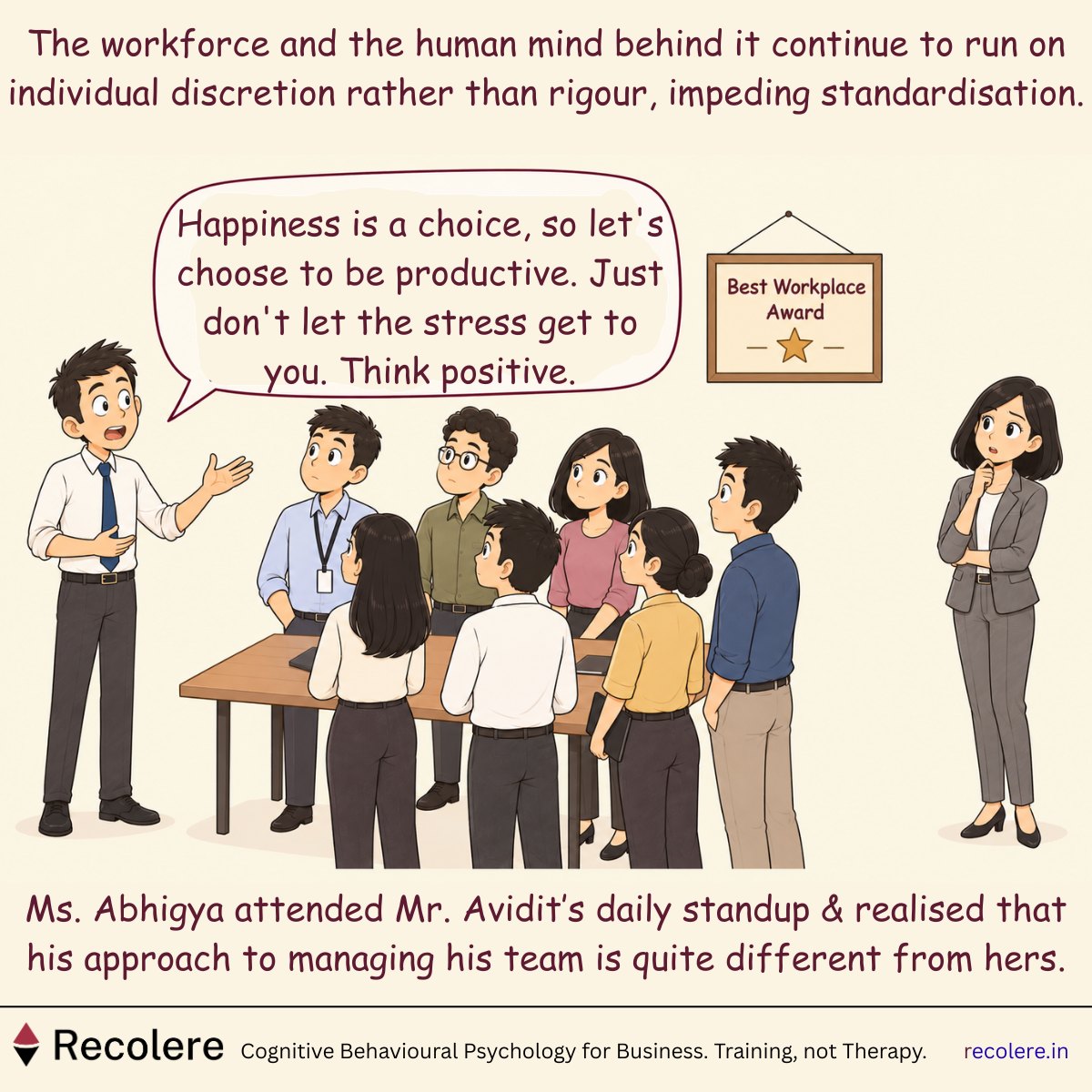
But there's one variable almost no function has managed to bring rigour to: the human mind itself. Arguably the organisation's most important resource - and the one still run almost entirely on individual discretion. Ask five managers to handle the same conflict, the same underperformance, the same difficult conversation, and you'll often get five different approaches. That inconsistency is a standardisation gap - and it quietly consumes a lot of organisational energy and focus.
Here's what's changed: psychology - specifically its cognitive behavioural tradition (CBT, REBT, etc.) - has matured into something structured and evidence-based to close that gap. Not by replacing discretion, but by giving it the same rigour every other function already has.
That reframes what's possible for productivity, quality, innovation, value creation, etc. - as a business problem with a psychological substrate.